
Ever had a great game idea but you get discouraged as soon as you see a bunch of arcane lines of code? It’s disappointing when you have all these great ideas and no technical expertise to make them a reality. You are not alone in your stuckness! There are literally thousands of would-be creators who hit the same wall every day.
That’s where a modern no-code game maker like Astrocade comes in to the rescue. Astrocade is a natural language gaming platform that lets you create full, playable games from natural language prompts without coding. In this post, let’s see how these visual programming tools remove the technical nightmare and enable you to create playable reality from your ideas. Get ready to learn the best game-changing benefits that will allow you to begin building today!
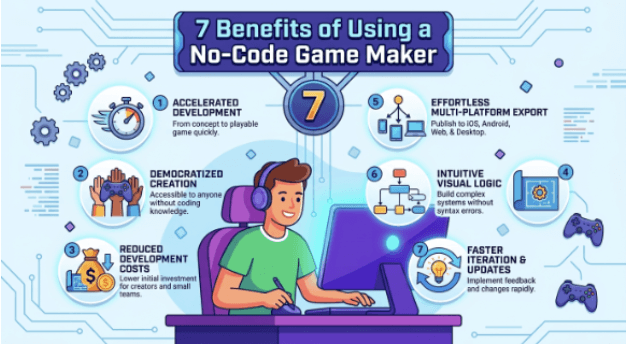
Build games fast
Normal software development can take months or years before you have a running prototype. Once you strip out programming syntax, your production rates skyrocket. You can concentrate on level design, gameplay, and art and not be mired down by bugs in your code.
This pace of progress means indie game developers can go from rough concept to working build in a handful of days. You can make quick iterations on your mechanics and adjust elements of a level interactively in real time. Rapid iterations keep your creative momentum high and prevent you from burning out on a project.
Skip complex code
Learning programming languages like C++ or C requires many long years of hard work. A visual engine substitutes text-based logic with intuitive node systems and easy drag-and-drop tools. Like “when player touches coin, add point,” you define simple rules with plain visual blocks rather than writing syntax line by line.
This visual aesthetic makes game development accessible to storytellers, artists and designers without technical expertise. You don’t need a computer science degree to build interactive worlds anymore. By removing the technical barrier, you get to keep your mind on making enjoyable gameplay rather than debugging missing semicolons.
Spend less money
Employing dedicated programmers is generally the costliest aspect of software development. Affordable no-code game maker is the equalizer for solo developers and small teams. You save thousands of dollars up front by doing the mechanics yourself with visual scripting tools.
Many of these platforms also come with free assets, templates, and sound effects. You don’t have to purchase any expensive third-party packages in order to release your project. This huge cut in overhead cost makes indie development much safer and more accessible.
Test ideas fast
Fast prototyping is essential to knowing if a mechanic is actually fun to play. Visual scripting tools enable you to quickly put together a simple functional test scene in a matter of hours. You can test mechanics live, get feedback from users, and throw out bad ideas before you waste months of work.
If a leap distance feels off, or a puzzle doesn’t quite land, you can tweak variables on the fly. Adaptable game design templates facilitate the transition. You find out what works by fast testing, not by guessing.
See also: How Technology Is Reshaping Creative Industries
Export to mobile
Creating a good title is only half the game - the rest is getting it into players’ hands. Modern visual declaring platforms include cross-platform exporting and your projects can be compiled as iOS, Android and web browser applications with just a few clicks. You don’t need to write separate native code bases for each platform you want to run on.
The mobile game stores’ opportunity to reach a worldwide audience provides millions of potential customers for indie studios. You can skip endless hours of porting and go live on day one everywhere. One build pipeline lets you target multiple platforms zero headache.
Conclusion
You no longer need years of computer science training or a huge financial budget to get started in interactive production. With technical roadblocks out of the way, a new-age no-code game creator lets you concentrate on what really matters: fun mechanics, captivating stories, and imaginative worlds. From simple puzzle games to action platformers, the tools around today help make your games faster and much more fun to create.
Turn your game ideas into games you can play right now. This is the best time ever! Begin playing around with a visual platform, prototyping your game early, and putting your work out there. Whether you want to create a game like Obliterate Earth or explore your own original concept, your journey as an indie developer starts when you stop reading coding books and start making.
FAQs
Can you really make a commercial game without coding?
That’s right several popular indie games on Steam and mobile app stores were made entirely in visual engines. Today’s visual tools obscure complex physics, memory management, and rendering so you can produce titles that are polished and ready for publication.
Is a visual game engine good for complete beginners?
To me, that is wholly fair. Visual tools are built from the ground up to be easy for non-technical people to use. The user-friendly drag-and-drop features are designed to make the learning process go very quickly and to make the work fun.
Can I export my game to multiple platforms?
The majority of modern visual game makers allow one-click cross-platform export. You can export your project straight to PC, mobile (iOS and Android), and web without having to rewrite the foundational logic of your game.
What types of games can I create with visual tools?
CREATE virtually any genre, from 2D platformers and top-down action games to RPGs, puzzle games, and endless runners. Far complex multiplayer games may need custom script nodes, but regular 2D and 3D games are supported in their entirety.
Are visual platforms free to use?
Most platforms have free levels or free trials that allow you to use the core engines and the built-in content. Some tools are paid via monthly subscription, others take a small cut of your revenue, or charge only when you export to particular commercial platforms.
